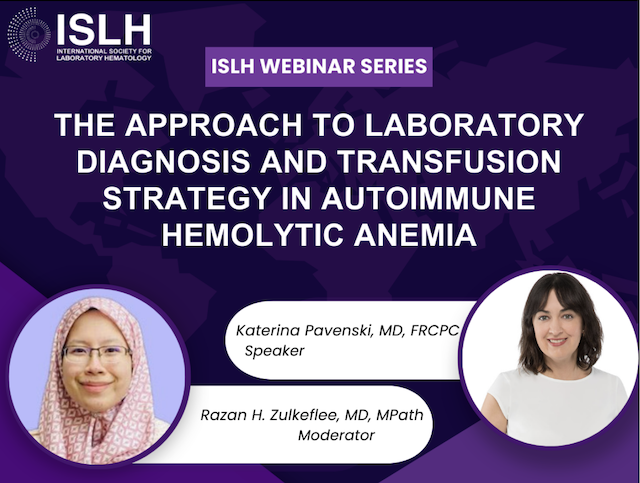
Webinar ISLH di febbraio 2026
05/02/2026
Inizia l'attività didattica 2026 della International Society for Laboratory Hematology (ISLH).
Giovedì 19 febbraio alle 17 italiane (11:00 AM ET), Katerina Pavenski, MD, FRCPC, St. Michael’s Hospital – Unity Health Toronto; Associate Professor; University of Toronto, Toronto, Canada presenterà un seminario dal titolo: "The Approach to Laboratory Diagnosis and Transfusion Strategy in Autoimmune Hemolytic Anemia".
Razan H. Zulkeflee Department of Hematology, School of Medical Sciences, Health Campus, Universiti Sains Malaysia, sarà la moderatrice del webinar.
La partecipazione è gratuita.
Non perdete questo evento formativo!
Overview:
Warm autoimmune hemolytic anemia (WAIHA) is a rare disease with a highly heterogeneous clinical course. It may lead to transfusion dependence and other complications including mortality.
Diagnosis is based on presence of anemia, biochemical evidence of hemolysis, spherocytosis on blood film, and a positive direct antiglobulin test (DAT) due to IgG. Red blood cell (RBC) autoantibodies may mask presence of alloantibodies and interfere with pre-transfusion testing.
There are concerns about poor response to transfusion, worsening hemolysis, and increased RBC alloimmunization risk in patients with WAIHA. Additional blood bank investigations are frequently performed but may lead to transfusion delay, and hence clear and timely communication with a clinical team is imperative. Most commonly, prophylactic antigen matched RBC are transfused.
However, this strategy has not been shown to reduce RBC alloimmunization as compared to no matching strategy. In cases of severe anemia, RBC should be issued without delay. Even though studies on RBC transfusion outcomes in WAIHA are scarce, limited evidence suggests that RBC transfusions in WAIHA are effective and safe. As per one study, the least incompatible RBC without prophylactic antigen matching may produce reasonable hemoglobin increments and the risk of transfusion complications is low. The cornerstone of treatment is immunosuppression, and a number of novel therapies are currently under investigation.
Learning Objectives:
-
Describe laboratory diagnostic work-up for warm autoimmune hemolytic anemia (WAIHA).
-
Explain how to select red blood cells for transfusion to patients with WAIHA.
-
Give a brief overview of pathophysiology and current therapies for WAIHA.
Notizie collegate