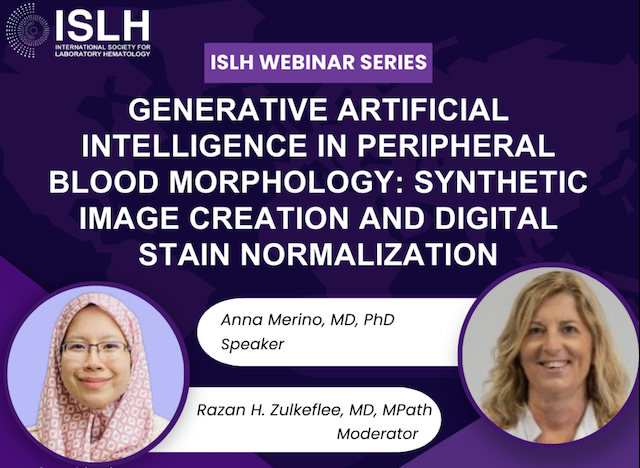
Webinar ISLH di settembre 2026
07/09/2026
Al rientro dalle vacanze, la International Society for Laboratory Hematology (ISLH) ci propone un interessante seminario.
Giovedì 17 settembre alle 17 italiane (11:00 AM ET), Anna Merino, MD, PhD, Hospital Clínic of Barcelona, Core Laboratory, Spain, presenterà un seminario dal titolo: "Generative Artificial Intelligence in Peripheral Blood Morphology: Synthetic Image Creation and Digital Stain Normalization".
Razan H. Zulkeflee, Department of Hematology, School of Medical Sciences, Health Campus, Universiti Sains Malaysia, sarà la moderatrice del webinar.
La partecipazione è gratuita.
Non perdete questo evento formativo!
Overview:
The morphological analysis of peripheral blood cells is increasingly adopting deep learning, mainly for the automatic recognition of the variety of normal and abnormal cell classes. However, its clinical application is limited by the scarcity of annotated datasets for rare diseases and the high variability of staining protocols between laboratories.
This presentation provides an overview of how Generative Artificial Intelligence methods can help overcome these obstacles. Firsts, some basic concepts are presented, specifically generative adversarial networks (GANs). Two problems are discussed:
1) the automatic generation of artificial blood cell images and
2) the digital artificial staining to reduce inter-laboratory differences.
It will be shown how high-quality image of blood cells with realistic morphological characteristics are created, which strengthen the classifier’s training. In multicenter tests, the examples illustrate that normalizing the staining allow a classifier trained on abnormal blood cell images from a single hospital to accurately recognize abnormal cells obtained in other laboratories, significantly improving performance without distorting cell morphology.
A final section concludes with observations and future perspectives on how generative tools can assist clinical pathologists as decision support systems that can operate consistently across diverse clinical settings.
Learning Objectives:
-
Learn about the use of generative adversarial networks for the automatic generation of normal and abnormal artificial blood cell images.
-
Understand how the digital artificial staining may reduce the high variability of staining protocols between laboratories.
-
Discuss about future perspectives on how generative tools can assist clinical pathologists as decision support systems.
Notizie collegate